Introduction
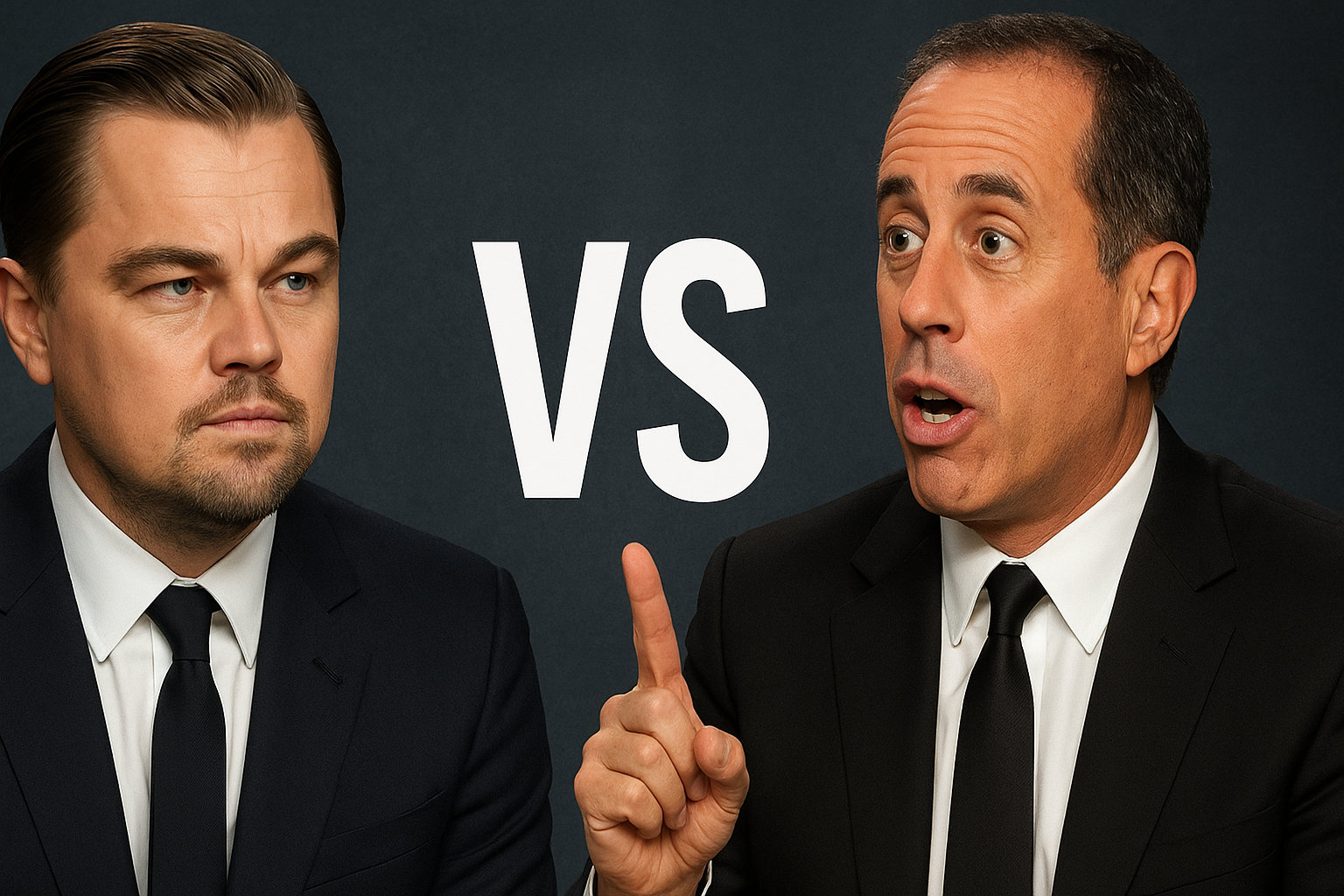
Leonardo DiCaprio and Jerry Seinfeld are two of the most influential figures in modern entertainment, yet their careers could not be more different. DiCaprio built his legacy on decades of critically acclaimed films, record-breaking box-office performances, and a reputation as one of Hollywood’s most transformative actors. Seinfeld, on the other hand, reshaped television comedy with a single groundbreaking series that continues to generate massive cultural and financial impact decades after its finale.
Comparing these two icons means comparing film vs. television, actor vs. comedian, box-office power vs. syndication empire, and philanthropy vs. cultural influence. This long-form analysis breaks down their careers, earnings, accolades, streaming value, impact on pop culture, and who “wins” across major categories in 2025. The result is a data-driven, balanced comparison that reveals how two very different paths can lead to entertainment immortality.
Quick facts
Leonardo DiCaprio
- Full name: Leonardo Wilhelm DiCaprio.
- Known for: Film actor, producer, and environmental activist.
- Active years: 1989–present.
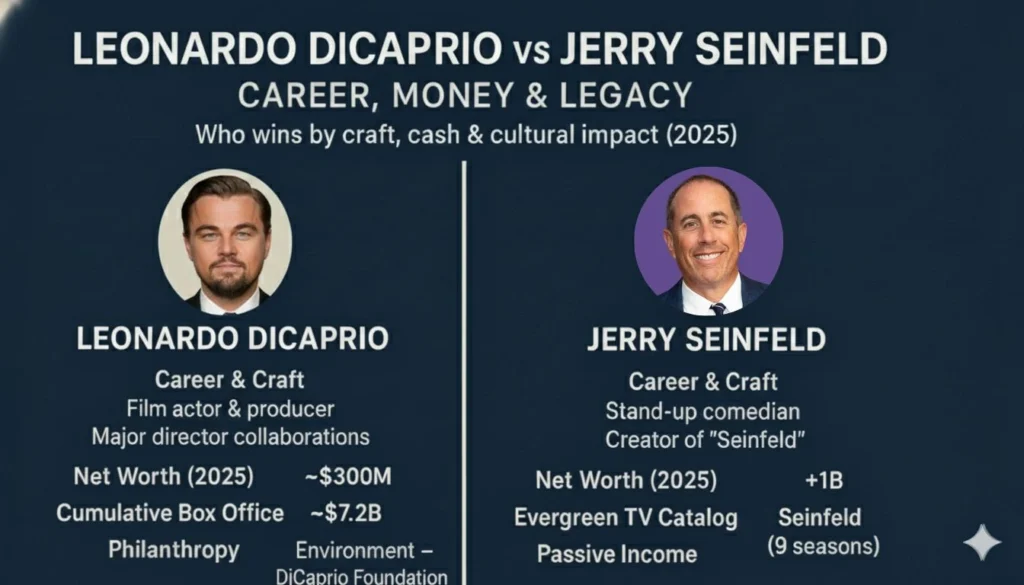
- Estimated net worth (2025): ~US$300M (public estimates).
- Cumulative box-office (approx.): ~US$7.2 billion worldwide across films.
Jerry Seinfeld
- Full name: Jerome Allen Seinfeld.
- Known for: Stand-up comedy; creator/star of Seinfeld; Comedians in Cars Getting Coffee.
- Active years: 1976–present.
- Estimated net worth (2025): >US$1B (Bloomberg Billionaires Index, 2024).
- Primary earning engine: Syndication, licensing, streaming, touring, licensing.
Verdict
- Best actor/craft (range & awards): Leonardo DiCaprio.
- Best TV cultural legacy & passive income: Jerry Seinfeld.
- Who is richer (headline net worth): Jerry Seinfeld (> $1B).
- Most bankable single-project draw: Leonardo DiCaprio.
- Short takeaway: Different objectives DiCaprio’s career optimizes for craft + high-performance payoffs; Seinfeld’s optimizes for durable IP and long-tail monetization.
Quick comparison table
| Metric | Leonardo DiCaprio | Jerry Seinfeld |
| Primary medium | Film (actor/producer) | Stand-up, TV (creator/star/producer) |
| Active years | 1989–present | 1976–present |
| Notable works | Titanic, Inception, The Revenant, Killers of the Flower Moon | Seinfeld (1989–1998), Comedians in Cars Getting Coffee, Unfrosted |
| Cumulative earnings model | Big per-film salaries + producer backend + investments | Syndication + streaming licenses + touring + licensing |
| Net worth (est. 2025) | ~US$300M | >US$1B |
| Cultural footprint | Global film prestige & awards conversations | Everyday cultural language; high meme density & rerun economy |
Career & craft: Film actor vs stand-up/TV creator
When we compare career trajectories using an NLP metaphor, we treat each artist as a time series of feature vectors. Each project (film, episode, tour, special) adds features: critical acclaim, box-office vectors, syndication weight, streaming recency signals, awards tokens, and public-cause embeddings.
Leonardo DiCaprio, the cinematic chameleon
DiCaprio’s vector is strongly clustered around auteur collaborations and awards-season momentum. Early critical tokens (e.g., What’s Eating Gilbert Grape) created an initial attention spike that magnified after Titanic, which served as a Global-Distribution boost. He then optimized his career by aligning with high-authority director embeddings Scorsese (multiple collaborations), Christopher Nolan, Quentin Tarantino, and Paul Thomas Anderson, which functionally increased his feature weights for both critical and box-office performance. DiCaprio’s Appian Way production company acts like a model fine-tuning routine: it gives him creative control, additional credits, and backend participation that change the gradient of his earnings over time. The film corpus associated with DiCaprio aggregates to multiple billions in global revenue, which in turn strengthens his negotiating power for high per-film fees and backend points.
Jerry Seinfeld, the craftsman of observational comedy and sitcom economy
Seinfeld’s career vector is trained on repetition and pattern recognition, observational comedy that maps small, everyday inputs into high-signal, low-noise punchlines. Seinfeld, the show, is a textbook example of high-quality, low-marginal-cost content: after it was produced (nine seasons), each subsequent licensing event (syndication, streaming) contributes revenue with minimal additional production expense. The show’s episodes, catchphrases, and situational beats have high transferability: they migrate into everyday speech, remain discoverable across generations, and keep accruing value through licensing cycles. Outside of the sitcom, Seinfeld’s stand-up and web content reinforce the brand, while curated projects like Comedians in Cars Getting Coffee keep the core persona active in lower-friction formats.
Who “wins” craft?
It depends on the metric. If the evaluation metric is acting range, auteur collaborations, awards, and cinematic ambition, DiCaprio wins. If the metric is from innovation, cultural stickiness, and a content-first licensing economy that keeps generating passive cash flow, Seinfeld wins.
What creators should extract: actors can learn from DiCaprio’s selective project choices and producer leverage; TV creators and comedians can learn from Seinfeld’s discipline for repeatable formats and IP control.
Money & business: How the fortunes were made
Viewing each career through an earnings-mechanism lens shows two paradigms: front-loaded, hit-driven compensation (DiCaprio) versus catalog-driven, recurring licensing (Seinfeld).
DiCaprio’s income model
DiCaprio’s revenue features: large upfront fees for blockbuster films, backend participation as producer, overseas box-office multipliers, and diversified investments (real estate, eco-startups, brand partnerships). High prestige films also deliver non-monetary value: awards that translate into higher future fees. Publicly available trackers and business profiles commonly estimate his net worth to be ~US$300M in 2025, a composite of salaries, production earnings, assets, and investments.
Seinfeld’s passive-income machine
Seinfeld’s net-worth profile is dominated by the syndication and licensing lifecycle from the original nine seasons. Once a TV series of the right quality and reach exists, it can be repeatedly licensed to networks and streaming platforms. Each new license is high-margin revenue because the episodes already exist; the marginal cost is near zero. Bloomberg’s coverage estimated Jerry Seinfeld’s net worth in billionaire territory (2024) and highlights syndication and licensing as principal components. This result underscores an economic truth: owning durable IP can produce compounding, long-term cash flows that eclipse even very high per-project fees earned by film stars.
Who “wins” money?
- Headline net worth advantage: Jerry Seinfeld.
- Per-project or prestige earnings and single-project bankability: Leonardo DiCaprio.
Creator takeaway: there are two stable strategies: build high-margin, evergreen IP (TV catalogs, franchises, platforms) for compounding passive income; or continually win high-value, high-visibility projects and capture a premium through salary + backend + targeted investments.
Cultural impact & legacy
When we model cultural impact, we think in terms of reach (how many people see the work), penetration (how deeply the work affects language/behavior), durability (how long the work remains discoverable), and influence on craft (how the work shapes future creators).
DiCaprio: cinema, awards season, and civic causes
DiCaprio’s name is a high-salience token in conversations about modern cinema. Films like Titanic were global cultural events, while projects like Inception and The Revenant generated both box-office and awards-season signals. DiCaprio’s collaborations with major directors function as credibility amplifiers: directors want his brand when they need both critical and commercial clout. Beyond cinema, DiCaprio’s environmental activism (through his foundation) adds a civic dimension to his public persona. That causes his name to carry not only an artist-token but also an activist-token in digital discourse.
Seinfeld: cultural saturation and everyday language
Seinfeld’s impact is uniformly pervasive in daily conversation. Concepts from the show, phrases, episode formats, and joke structures have entered the cultural lexicon. Syndication ensured continuous discovery for new generations; streaming deals and clip circulation online maintain meme-level activity. In linguistic terms, Seinfeld created durable lexemes and pragmatic templates people still use. Its influence is less about prizes and more about shaping social language and comedy scaffolding.
Who “wins” influence?
- For actorly craft and awards-influence: DiCaprio.
- For everyday cultural language, memetic spread, and multi-generation recall: Seinfeld.
Both careers produce influence, but in different vector subspaces: DiCaprio in prestige and craft, Seinfeld in ubiquity and lived cultural grammar.
Philanthropy, public image & controversies
Philanthropy and public image are secondary features that modulate celebrity legacy. They alter how cultural outputs are framed.
Leonardo DiCaprio
DiCaprio’s philanthropic feature vector is strongly biased toward environmental causes. The Leonardo DiCaprio Foundation funds conservation projects, scientific research, and documentary partnerships. His activism is public-facing and connects his celebrity to environmentalist and sustainability nodes, which influences brand partnerships and press narratives. Controversies, when they arise, are often related to the usual celebrity cycles, relationships, and property disputes, and rarely erode his reputation as a serious artist and activist.
Jerry Seinfeld
Seinfeld’s philanthropic profile is present but lower in public political signal. He tends to be private and calculated about public exposure. When the press covers Seinfeld, it often emphasizes his syndication savvy and business acumen over activist Commitments. Controversies around Seinfeld tend to be routine and not politically polarizing; they rarely dominate his public profile long-term.
Summary: Both are philanthropic and maintain broadly positive public images; DiCaprio’s activism makes him visible in public-cause contexts, while Seinfeld’s persona is more centered on creative/business stewardship and private life.
Head-to-head: Who “wins” for each metric?
A compact verdict across key metrics:
- Best actor/prestige & awards: Leonardo DiCaprio. (Acting range, Oscar, auteur partnerships.)
- Best TV cultural legacy/household recognition: Jerry Seinfeld. (Seinfeld’s cultural saturation + rerun economy.)
- Largest headline net worth (2025): Jerry Seinfeld. (Bloomberg’s billionaire valuation, 2024.)
- Most bankable single project: Leonardo DiCaprio. (Tentpole box-office draw.)
- Best for creators to study: Both. DiCaprio for craft, director relationships, and selective producing; Seinfeld for IP ownership, syndication strategy, and brand durability.
Where to watch: streaming & syndication
Seinfeld: Seinfeld moved to Netflix under a global streaming arrangement that began in the 2020–2021 window; availability can vary by region and future license renewals. For up-to-the-minute availability, check regional streaming guides (e.g., JustWatch) or platform catalogs.
DiCaprio films: DiCaprio’s filmography is distributed across multiple studios, so titles rotate between services. Major films like Titanic, Inception, and The Revenant appear on different platforms over time. Recent theatrical releases follow theatrical → VOD → streaming windows depending on studio strategy. Again, use a streaming-availability aggregator to locate the current platform for a specific film.
Deep-dive: Box office, earnings mechanics, and the syndication difference. Box office & backend (DiCaprio)
Actors monetize with a blend of upfront fees, backend (profit participation), and sometimes gross points (a percentage of box office receipts). DiCaprio frequently negotiates producing credits or backend points that meaningfully increase his upside when films perform strongly. His career totals (films cumulatively grossing ~US$7.2 billion worldwide) make him a top-line negotiator for major studios.
Syndication & licensing (Seinfeld)
Television catalogs differ: after production, episodes can be licensed repeatedly. Each license to broadcast networks, cable channels, or streaming platforms generates revenue without the need to produce new episodes. This creates a compounding revenue stream for durable, widely appealing shows. Seinfeld is a signature example: its nine seasons continue to earn through syndication, streaming, and clip-based consumption.
Comparative mechanics table (text)
| Mechanic | DiCaprio (Film) | Seinfeld (TV) |
| Upfront pay | High per-film salary | Historically lower per-episode, but scale through syndication |
| Backend | Producer points on select films | Syndication residuals + licensing deals |
| Scalability | Per-film — costly to scale | One product → many licenses (high scalability) |
| Risk profile | High (marketing + production costs) | Low marginal cost for reruns/licensees |
| Path to billionaire | Requires repeated huge hits + investments | Easier with a globally licensed catalog |
Full Biographies
Leonardo DiCaprio is an Academy Award-winning film actor known for blockbuster hits and serious dramas. He rose to prominence in the 1990s (notably on Titanic) and crafted a career by working with leading directors. Through both starring roles and producing via Appian Way, he’s become one of the most visible movie stars of his generation and a prominent environmental philanthropist.
Who is Jerry Seinfeld, and why is he famous?
Jerry Seinfeld is a stand-up comedian who co-created and starred in Seinfeld, one of the most influential and commercially successful sitcoms in TV history. The show’s focus on the humor of everyday life made it endlessly rewatchable and highly licensable, producing decades of syndication revenue. Seinfeld continues to perform stand-up and to create content aligned with his straightforward, observational comic voice.
Net worth 2025: The numbers & what they mean
Net worth estimates synthesize public records, reported deals, business modeling, and asset appraisals. They vary by source but provide useful order-of-magnitude context.
- Leonardo DiCaprio: Public estimates converge around US$300M in 2025. This figure includes acting fees, producer proceeds, investments, and property. DiCaprio’s earnings profile is a mixture of high upside from individual films and ongoing returns from production credits and investments.
- Jerry Seinfeld: Bloomberg’s Billionaires Index valued Seinfeld at over US$1 billion in 2024. That headline number is driven largely by syndication, streaming licensing, and recurring revenue from decades of TV ownership. Seinfeld’s case illustrates that a single, well-licensed catalog can generate concentrated, long-term wealth.
Interpretation: DiCaprio’s portfolio is high-velocity and project-centric; Seinfeld’s is slow-burning and catalog-driven. Both strategies produce durable wealth, but the latter has structural advantages for long-term passive income.
Assets, lifestyle & highlights
DiCaprio: Known for high-end real estate holdings, eco-investments, and a public philanthropic silhouette focused on conservation. His lifestyle is consistent with a major movie star: selective public appearances and high-profile film premieres.
Seinfeld: Known for valuable real estate (including Manhattan holdings) and an iconic car collection. His lifestyle emphasizes privacy and strategic media appearances; his business reputation centers on his savvy handling of his TV catalog.
Relationships & personal life
DiCaprio: Media interest often focuses on his relationships and romantic life, though he maintains a degree of privacy. He’s widely covered for both professional choices and personal associations.
Seinfeld: Married with family life largely kept private. He tends to avoid generating tabloid-level controversy and maintains a careful public presence.
Fun facts/trivia
DiCaprio founded Appian Way to produce projects he believes in.
- Seinfeld introduced phrases and situational formats that remain part of daily speech.
- Both have leveraged their core crafts into business ventures external to their original mediums.
FAQs
A: Yes, Bloomberg reported Jerry Seinfeld’s net worth at over US$1 billion in 2024, while public estimates for Leonardo DiCaprio are commonly around US$300 million.
A: DiCaprio has major film awards (including an Academy Award for Best Actor). Seinfeld has TV awards and a huge cultural influence. They win in different award worlds.
A: Seinfeld moved to Netflix in a high-profile global streaming deal (the deal took effect in 2021). Availability can change by country and license. Check local streaming guides.
A: Study DiCaprio for director relationships, careful role choices, and producing as a way to increase creative control. Study Seinfeld for how to build a repeatable product and license it for long-term income.
Pros & Cons quick decision aid
Leonardo DiCaprio
- Pros: Acting range, awards credibility, strong theatrical draw, careful project selection.
- Globally acclaimed film actor with long-lasting box-office success
- Cons: Film income is lumpy and depends on the success of individual projects.
Jerry Seinfeld
- Pros: Evergreen TV IP, syndication, and streaming licensing create long-term passive income and, enormous cultural reach.
- Cons: Much headline wealth is concentrated in a single catalog asset.
- Less global cinematic influence than DiCaprio
Conclusion
Which trajectory “wins”? It depends entirely on the evaluation axis. Leonardo DiCaprio triumphs when the metric is acting craft, awards pedigree, and the capacity to be the actor of choice for auteurs who need both prestige and box-office weight. Jerry Seinfeld triumphs when the metric is everyday cultural saturation, meme-level recall, and the superior economics of owning durable IP that can be licensed repeatedly.
Bloomberg’s valuation of Seinfeld in 2024 (placing him in billionaire territory) is a compelling empirical lesson about the asymmetric economics of catalog ownership. Meanwhile, DiCaprio’s approximately US$300 million net worth and multi-billion-dollar film corpus illustrate a different playbook: high compensation per project, plus selective producing and investment. For creators: study both blueprints. DiCaprio offers a model for cultivating craft and prestige while negotiating upside; Seinfeld offers a model for building a product that continues to pay after the initial creative labor ends.