Introduction
When you pick up a thriller that keeps you turning pages late into the night, odds are high it’s written (or at least stamped) by James Patterson, a name synonymous with bestsellers and one of the most prolific authors of our era. With hundreds of titles spanning adult thrillers, young-adult fiction, and middle-grade children’s books, his reach extends across generations and genres. But beyond the sheer volume of sales and a recognisable brand, Patterson’s story offers deeper angles: from a career pivot in advertising, to a reading advocacy champion, a co-author engine, a daily work model disruptor, and the subject of literary praise and criticism.
In this full-length guide, you’ll find everything from his quick facts and biography to reader-friendly curated book lists, series by reading order, an inside look at his writing and publishing model, his philanthropy, controversies, latest news, and FAQs designed for both newcomers and die-hard fans. By the end, you’ll not only know which Patterson book to dive into next, but why his impact matters.
Quick Facts
Early Life to Education
James Patterson was born in Newburgh, New York, into a working-class family: his mother, Isabelle, was a teacher and homemaker, and his father, Charles (or in some sources “Charles Henry”), was an insurance broker.
He attended Manhattan College and earned a B.A. in English, summa cum laude. He then went on to Vanderbilt University for a master’s in English, though he did not complete the full doctoral path. Before writing full-time, Patterson enjoyed a successful career in advertising—he worked at the agency J. Walter Thompson (JWT) and rose through the ranks. Interestingly, Patterson admits he wasn’t a voracious reader during his early childhood; reading came later, especially through his night-shift work in a mental hospital, where he began devouring books. (This aspect is often referenced in his origin story, though in fewer formal sources.)
Career Journey
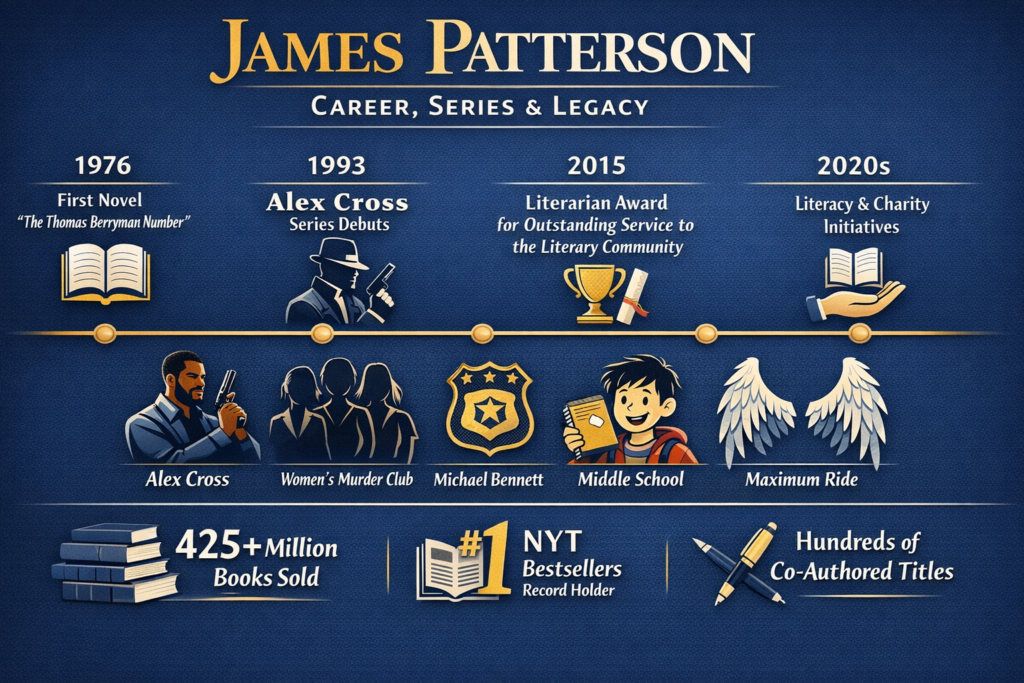
His first novel, The Thomas Berryman Number, was published in 1976 and won the Edgar Award for Best First Novel. His big commercial breakthrough came in 1993 with Along Came a Spider, the first book in the Alex Cross series, which he marketed aggressively (including creating his own TV ad campaign)
Expansion & productivity
From the 2000s onwards, Patterson diversified: thrillers for adults, romantic suspense, YA, and children’s fiction. He began collaborating with co-authors to maintain a high output. His books have sold more than 425 million copies (various estimates), and he holds the Guinness World Record for most New York Times #1 bestsellers by a single author.Later years & legacy building: Beyond writing, Patterson has become a significant voice in literacy, education, and has shown that authorship can be a brand and business. His philanthropic efforts have grown and maintained media visibility.
Timeline: Major Books & Career Milestones
Best James Patterson Books Curated Lists by Mood
- If you want a classic Patterson thriller
Along Came a Spider (Alex Cross) iconic start.
Kiss the Girls is high tension, classic crime. - If you prefer a modern standalone thriller
The President Is Missing (co-written with Bill Clinton) major collaboration with, broad appeal. - For kids & reluctant readers
Middle School: The Worst Years of My Life is funny, relatable, and easy to digest. - For fans of short, fast reads
Patterson’s “BookShots”/shorter thrillers: designed to be quick, addictive reads.
Comparison Table
| Reader Goal | Recommended Title | Why it fits |
| Classic thriller | Along Came a Spider | Launch of Alex Cross; signature style. |
| Modern standalone | The President Is Missing | Top-level collaboration; political thriller. |
| Middle-grade reader | Middle School: The Worst Years of My Life | Engaging for a younger audience; accessible. |
| Quick read | Patterson’s BookShots series | Compact format, fast pacing. |
How James Patterson Writes
One of the most intriguing parts of Patterson’s career is how he writes.
- Patterson frequently uses co-authors: he develops detailed outlines, then collaborates to flesh them out.
“He doesn’t even try to hide his use of co-authors.” - His style favours very short chapters, high momentum, and minimal “fat”. He once said, “outline, outline, outline” is foundational.
- This model has allowed him to publish multiple titles per year across genres and turn “James Patterson” into a brand. Critics say the model prioritizes quantity over literary depth; supporters say it democratizes reading, targets reluctant readers, and expands readership.
- He also uses marketing savvy (recall the TV ad for Along Came a Spider), a reminder of his advertising background.
Philanthropy & Literacy Work
Beyond books, Patterson has committed significant resources to promoting reading and literacy:
- He has donated millions of dollars and books to libraries, independent bookstores, teacher-education programmes, and children’s reading initiatives
- For example, He established the PageTurner Awards to support creative reading projects and launched the site ReadKiddoRead to help parents and educators.
- Most recently, he launched the “Go Finish Your Book” initiative, offering grants of up to US $50,000 to emerging authors.
These aspects of his legacy strengthen his standing not just as a commercial author but as someone actively working to influence the reading ecosystem.
Controversies & Criticism What Readers Ask
Like Any Major figure, Patterson’s career has also attracted criticism and debate. Here are some of the common discussion points:
Co-authorship model
Some critics argue that because he uses many co-writers, the “James Patterson” brand may dilute an individual authorial voice or suggest more factory-style production.
Supporters say the model expands reach, supports new authors, and serves readers who prefer fast, plot-driven fiction.
Commercialization of fiction
While immensely successful, Patterson’s work is sometimes dismissed by literary critics as “formulaic” or lacking in literary depth.
“His books are essentially junk food … our patrons love them.”
“They’re not particularly long or complex books.”
Notable friction: Stephen King once called him “a terrible writer … but very successfulRecognizing the validity of these critiques gives your content balanced authority and appeals to searchers querying “Is James Patterson a good writer?”
Volume vs. quality debate
With multiple titles a year, some readers question whether quality suffers for quantity. This is a nuanced topic worth addressing for a pillar article, rather than glossing over.
Latest News & Upcoming Releases
Keeping this section fresh helps cater to timely search queries and signals to Google (and readers) that the article is up to date. Some of the most recent developments:
- Patterson’s “Go Finish Your Book” initiative: Up to US $50,000 grants for emerging writers
- His reflections on the Stephen King comment and writing evolution.
- Collaboration news: e.g., Patterson co-writing a thriller with MrBeast (Jimmy Donaldson), illustrating his continued expansion into new media and partnerships.
FAQs
A: James Patterson is an American author born in 1947, best known for his thriller series (especially Alex Cross) and for being one of the bestselling writers in modern publishing.
A: While exact numbers fluctuate, Patterson has published hundreds of titles across adult, young-adult, and children’s fiction. His bibliography spans more than 30 years and includes multiple series and collaborations.
A: For thriller fans: Along Came a Spider (Alex Cross series) is a strong entry. For younger or reluctant readers: Middle School: The Worst Years of My Life offers accessible fun.
Conclusion
From Advertising executive to record-breaking novelist, James Patterson’s journey demonstrates how storytelling, productivity, and entrepreneurial thinking can combine to build a literary empire. Whether you’re a thriller-lover digging into the Alex Cross saga, a parent looking for an engaging read for a middle-schooler, or a reader curious about how the day of books runs today, Patterson’s work offers something for many. He may be dividing in literary critique, but his impact on reader engagement, on the publishing model, and on reading advocacy is indisputable.