Introduction
James Cameron is one of the most influential filmmakers in cinema history. He makes movies like an engineer solves problems, first defining the challenge, then inventing the tools to complete it. From low-budget sci-fi like The Terminator to record-breaking blockbusters like Titanic and Avatar, Cameron combines emotional storytelling with cutting-edge technology. His films revolutionized how studios plan large-scale productions, design VFX pipelines, and how audiences experience cinema.This guide provides an overview of his entire life, career, filmmaking style, technical achievements, controversies, legacy, and how to watch his films, along with key FAQs, all written in simple English for students, fans, journalists, and researchers.
Quick Facts
- Full Name: James Francis Cameron
- Born: August 16, 1954, Kapuskasing, Ontario, Canada
- Career Active: 1978 to present
- Occupation: Director, writer, producer, editor, deep-sea explorer
- Known For: Titanic, Avatar, Terminator series, groundbreaking VFX innovation
- Nationality: Canadian (with additional citizenship reported)
Why James Cameron Matters
James Cameron is special because he changed both filmmaking and film technology. When he needs a solution, a new camera, a new motion-capture rig, a new underwater system, or real-time virtual production, he builds it instead of waiting for the industry.
This has led to major advancements, including:
- Modern realistic CGI
- Photoreal motion capture
- Large-scale stereo 3D filmmaking
- Virtual production workflows
Today, almost every blockbuster uses pipelines Cameron helped pioneer.
Early Life & Education (1954–1977)
James Cameron grew up in Canada in a family where fixing and building things was normal. As a child, he:
- Built models
- Read science fiction
- Studied machines
- Learned how technology works
His family later moved to California, where he attended Fullerton College, studying physics and English. Instead of finishing his degree, Cameron left school to teach himself filmmaking. He:
- Watched films frame-by-frame
- Studied editing and effects
- Built miniature models
- Learned camera mechanics
This technical mindset became the foundation of his entire career.
Career Journey (Step-by-Step)
Early Career (Late 1970s – 1983)
Cameron began not as a director but as a miniature model-maker and production assistant on low-budget genre films. He learned:
- Lighting
- Mechanical effects
- Practical creature work
- Art direction
These jobs taught him how to solve problems creatively, even with limited budgets.
Breakthrough: The Terminator to Aliens (1984–1986)
In 1984, Cameron wrote and directed The Terminator, a lean story about a cyborg assassin sent from the future. The film:
- Was produced cheaply
- Became a major hit
- Launched both Cameron and Arnold Schwarzenegger
His next film, Aliens (1986), proved he could:
- Handle larger budgets
- Manage large casts
- Direct complex action sequences
It remains a major fan favorite in sci-fi cinema.
The Abyss to Terminator 2 (1989–1991)
Cameron then pushed himself further with:
- The Abyss (1989 has groundbreaking underwater cinematography
- Terminator 2: Judgment Day (1991) was a revolution in CGI and practical effects
The liquid-metal T-1000 became one of the most famous digital characters ever created, and T2 set a new standard for VFX.
Global Blockbuster Era: Titanic & Avatar (1997–Present)
Titanic (1997)
A mix of:
- Emotional human drama
- Large-scale sets
- Complex digital and miniature integration
Titanic:
- Won 11 Oscars
- Became the highest-grossing film ever at that time
- Proved Cameron could deliver a large spectacle with human emotion
Avatar (2009)
Avatar reinvented filmmaking with:
- Real-time motion capture
- Virtual cameras
- Photoreal digital characters
- Modern stereo 3D
It became the highest-grossing film in cinema history, and its sequel, Avatar: The Way of Water (2022), repeated massive worldwide success.
Signature Films & Why They Matter
- The Terminator (1984): Smart sci-fi using tight editing and bold ideas.
- Aliens (1986): Bigger scale, stronger emotional arcs, legendary action.
- The Abyss (1989): Underwater filmmaking breakthrough.
- Terminator 2 (1991): CGI milestone, the industry changed after T2.
- Titanic (1997): Human storytelling + spectacle at massive scale.
- Avatar (2009): Reinvented 3D cinema and performance capture.
- Avatar 2 (2022): Pushed digital effects and water simulation even further.
Filmmaking Style & Themes
Themes Cameron Uses Often
- Humanity vs technology
- Exploration of new frontiers (ocean, space, future)
- Survival under extreme pressure
- Characters earn victory through physical struggle
Stylistic Trait
- Crystal-clear story beats
- Strong visual clarity
- Detailed world-building
- Extensive pre-production planning
- Action with emotional stakes
Key Collaborators
- Producer Jon Landau
- Cast and crew who often return across projects
- Leading VFX houses and research teams
Technical Innovation
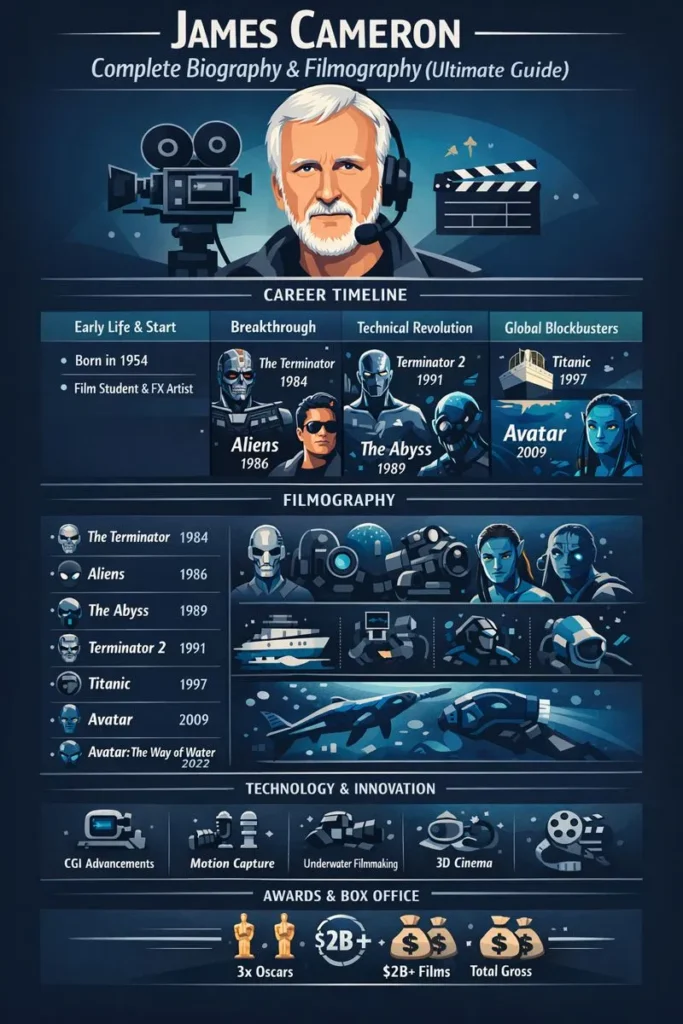
“James Cameron transformed both cinematic storytelling and film engineering.” His contributions include:
Underwater Cinematography
Developed new cameras and lighting to shoot underwater safely and clearly (The Abyss, Titanic, Avatar 2).
Photoreal Motion Capture
Made digital characters emotionally expressive instead of “wooden”.
Virtual Production
Directors and actors could “see” digital worlds live on set.
Advanced 3D Filmmaking
Avatar set new standards for stereo cinema.
These tools are now common in Hollywood.
Complete Filmography
| Year | Title | Role | Budget | Worldwide Gross |
| 1984 | The Terminator | Director, Writer | ~$7M | ~$78M |
| 1986 | Aliens | Director, Writer | $18M | $183M |
| 1989 | The Abyss | Director, Writer | $70M | ~$90M |
| 1991 | Terminator 2 | Director, Writer | $102M | $520M |
| 1994 | True Lies | Director, Writer | $100M | $378M |
| 1997 | Titanic | Director, Writer, Producer | ~$200M | $2.26B |
| 2009 | Avatar | Director, Writer, Producer | $237M | $2.74B |
| 2022 | Avatar: The Way of Water | Director, Writer, Producer | $350M+ | $2.34B |
Awards & Box-Office Records
- Titanic:
- 14 nominations
- 11 Oscar wins, including Best Director
- Avatar films sit near the top of global box office history
- Cameron is the only director with three different films crossing $2B
Controversies
Criticism often includes:
- Huge budgets and risky spending
- Extremely demanding Production processes
- Focus on technology sometimes over subtle character depth
Legacy & Influence
James Cameron proved:
- Blockbusters can be Emotional and smart
- Innovation is not optional sometimes; you must invent tools yourself
- Technology should always serve the story
Younger filmmakers and VFX artists still study his work like textbooks.
Upcoming Projects (2026 Outlook)
As of 2026:
- More Avatar sequels are in development
- Cameron continues to build new production systems for large-scale filmmaking
Frequently Asked Questions
He personally won three Oscars for Titanic.
It has repeatedly held the #1 position and remains among the top earners worldwide.
Advanced CGI, photoreal motion capture, underwater cinematography, and virtual production.
More Avatar sequels and related studio projects.
Estimated to be around $800 million (public sources).
Conclusion
James Cameron stands as one of the most important filmmakers in modern cinema history. He is not only a director but also a visionary storyteller, engineer, and innovator who permanently changed how Big Movies are made. From the low-budget sci-fi success of The Terminator to the global blockbusters Titanic and Avatar, Cameron has consistently pushed the limits of storytelling, technology, and scale.
What truly sets James Cameron apart is his ability to unite Story And Technology. He does not use visual effects simply to impress audiences; instead, he creates or improves technology to serve the story. His work in CGI, motion capture, underwater cinematography, 3D filmmaking, and virtual production reshaped the film industry and set new standards that are now common across Hollywood. “Despite criticism over big budgets and complex production, Cameron’s risks paid off, earning box-office success and critical acclaim. Few directors balance artistic ambition and commercial success so consistently. His legacy goes beyond records, proving that clear vision, preparation, and innovation can elevate cinema. For filmmakers and film lovers, Cameron remains a powerful example of imagination working with engineering.”