
Introduction
From humble auditions in Orlando’s entertainment scene during the early 1990s to conquering international pop charts and performing sold-out residencies in Las Vegas, the Backstreet Boys stand as one of the most iconic and enduring vocal groups in modern music history. Their evolution isn’t merely an evocative snapshot of the 90s; it’s a tale of transformation, creativity, resilience, and longevity.
This comprehensive guide takes you through every chapter of their story: from formation and early struggles to their Meteoric Rise, chart-topping reader, solo ventures, challenges, reinventions, and an unparalleled legacy. Whether you’re a casual listener discovering their music for the first time or a lifelong “Backstreeter,” this is your definitive deep-dive into the Backstreet Boys phenomenon.
Quick Facts
- Full Name: Backstreet Boys
- Nickname: BSB
- Genre: Pop / Dance-pop / Vocal group
- Formation Year: 1993
- Origin: Orlando, Florida, USA
- Nationality: American
- Years Active: 1993–present
- Core Members: Nick Carter, A.J. McLean, Howie Dorough, Brian Littrell, Kevin Richardson
- Estimated Sales: Over 130 million records worldwide, ranking them among the best-selling boy bands of all time.
Early Life & Formation (1993–1996)
Beginnings in Orlando
The Backstreet Boys’ origin story began in 1993, in Orlando, Florida, a hotbed for entertainment and youth talent. A local talent manager placed ads looking for young singers with strong harmonies and dancing skills. Among those who auditioned were A.J. McLean, Howie Dorough, and Nick Carter, who were soon selected. Not long after, Kevin Richardson, a performer from Kentucky working at Disney World, joined the group. Kevin later invited his cousin Brian Littrell to audition, completing the now-famous five-member lineup.
This combination of unique voices and personalities would become the foundation of one of the most commercially successful pop acts in history.
International Focus & Debut Album
Unlike many U.S.-based acts, the Backstreet Boys initially focused their energy on international markets, especially Europe and Canada, where the pop audience was receptive to melodic boy bands. Their self-titled debut album “Backstreet Boys” was released in 1996 in Germany and several European countries before it ever reached the U.S. market.
That strategic choice paid off. Europe became the testing ground where their harmonies, synchronized choreography, and relatable pop appeal refined the formula that would later conquer the world.
Building the Foundation
During these formative years, the group’s management carefully shaped what would later be called the “boy-band blueprint:” flawless vocal blends, energetic stage routines, emotionally charged lyrics, and a clean, camera-ready image. These elements would soon launch the Backstreet Boys into global superstardom.
Breakthrough & Global Domination (1997–2000)
The Million-Selling Era
By 1997, the Backstreet Boys had built a powerful fan base across Europe and were ready to take on America. Their second studio album, Backstreet’s Back, released internationally, became a phenomenon. Simultaneously, their U.S. compilation album (also titled Backstreet Boys) combined earlier European hits and introduced them to the American audience.
But their defining moment came with the release of Millennium (1999), their third studio album. Featuring timeless hits like “I Want It That Way,” “Larger Than Life,” and “Show Me the Meaning of Being Lonely,” Millennium was a cultural report. It sold more than 1.2 million copies in its first week in the U.S., becoming one of the fastest-selling albums of all time.
Worldwide Chart Success & Accolades
The group’s domination extended across continents. Their albums achieved multi-platinum and Diamond certifications, and their singles dominated both radio and MTV. Highlights include:
- Backstreet Boys and Millennium both achieved Diamond certification from the RIAA.
- They became one of the few pop groups in history to have their first ten albums debut in the Billboard 200 Top 10.
- The GRAMMY Museum recognizes them as one of the most influential pop collectives of the modern era.
Their sound defined an era of melodic harmonies, catchy hooks, and psychological sincerity that resonated across languages and cultures.
Signature Songs & Pop-Culture Impact
The Backstreet Boys’ late-’90s hits became the soundtrack of a generation. Among their most celebrated tracks:
- “I Want It That Way”
- “Everybody (Backstreet’s Back)”
- As you love me
- “Quit Playing Games (With My Heart)”
- “Show Me the Meaning of Being Lonely”
These tracks are now cultural artifacts appearing in films, TV shows, commercials, and nostalgia playlists worldwide.
Albums, Hits & Chart Milestones
Debut & Early Albums (1996–1998)
- Backstreet Boys (1996): The international debut, introducing their sound with “Quit Playing Games (With My Heart).”
- Backstreet’s Back (1997) cemented their presence in Europe and expanded global recognition.
- U.S. Backstreet Boys (1997) combined both previous releases for the American market, achieving enormous success.
Peak Era (1999–2000)
- Millennium (1999) was A Record-Breaking album that solidified their superstar status.
- Black & Blue (2000) continued their chart dominance, delivering mature themes and refined production.
Later Albums & Comeback (2005–2019)
- Never Gone (2005) marked a more mature pop-rock sound. Soon after, Kevin Richardson temporarily departed.
- Unbreakable (2007) and This Is Us (2009) were released as a quartet; both records showcased a more contemporary and R&B-influenced sound.
- In a World Like This (2013), their 20th-anniversary album, independently produced, reflected creative autonomy and emotional depth.
- DNA (2019) A powerful comeback, debuting #1 on the Billboard 200, nearly two decades after their last chart-topping release.
Table – Major Albums & Milestones
| Year | Album | Notes |
| 1996 | Backstreet Boys | International debut; success in Europe and Canada. |
| 1997 | Backstreet’s Back | Solidified international fame. |
| 1999 | Millennium | Cultural peak; record-breaking global sales. |
| 2000 | Black & Blue | Continued multi-platinum success. |
| 2005 | Never Gone | Mature evolution; temporary lineup change. |
| 2013 | In a World Like This | Independent project; 20th-anniversary milestone. |
| 2019 | DNA | #1 comeback album; critical resurgence. |
Trials, Line-Up Changes & Reinvention (2000s–2012)
Challenges and Changes
Even megastars encounter turbulence. The early 2000s saw the Backstreet Boys face personal, professional, and industry-wide challenges:
- Kevin Richardson left in 2006 to focus on family and theater pursuits.
- The band operated as a quartet, releasing Unbreakable (2007) and This Is Us (2009).
- Pop music tastes shifted dramatically from bubblegum pop to hip-hop and digital streaming, forcing the group to reinvent their sound and image.
Reinvention and Regrouping
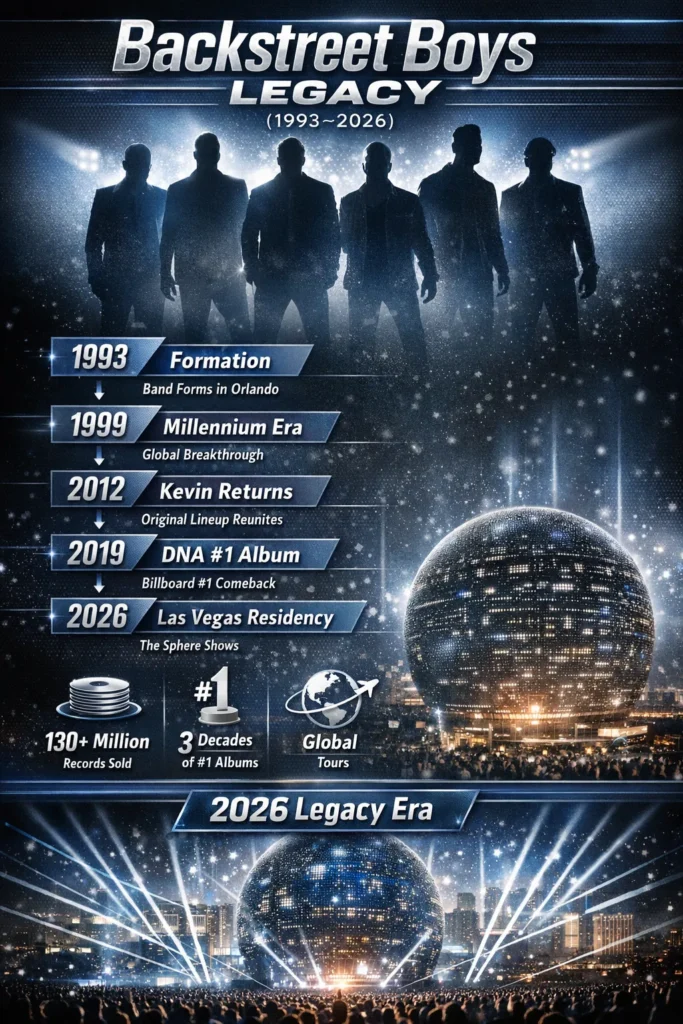
By 2012, the original five reunited when Kevin Richardson rejoined. The group then evolved from being a teen phenomenon to veteran performers who embraced their heritage while maturing musically. Their live shows transformed into celebrations of nostalgia, talent, and gratitude, blending old hits with new material that reflected adult perspectives.
This era defined their rebirth as a legacy act revered, respected, and resilient.
The Comeback Era Independence, DNA & Residency (2013–2026)
Going Independent
In 2013, the Backstreet Boys released In a World Like This, marking their first fully independent project. This bold move symbolized creative control, artistic freedom, and a new chapter of self-determination.
“DNA” and Historic Comeback
The 2019 album DNA debuted at #1 on the Billboard 200, making the group the first boy band to achieve #1 albums across three different decades. Songs like “Don’t Go Breaking My Heart” reminded the world that their vocal chemistry was timeless.
This era was proof of their adaptability: blending nostalgic harmonies with modern pop-electronic production while maintaining their emotional signature.
Las Vegas Residency & Legacy Showcase
In February 2026, the group announced an immersive Las Vegas residency titled “Into the Millennium” at The Sphere, paying tribute to their landmark 1999 album. Alongside it, they confirmed Millennium 2.0, a remastered edition set for release in July 2026.
This wasn’t just nostalgia; it was a reinvention of legacy performance, using cutting-edge visuals, AR effects, and fan-interactive storytelling to bridge generations.
Solo Careers, Acting & Ventures
Each member has explored individual projects, demonstrating both independence and unity:
- A.J. McLean released solo albums, appeared on Dancing with the Stars, and became an advocate for addiction recovery and mental health awareness.
- Nick Carter produced solo records, starred in reality shows like House of Carters, and published a memoir detailing his life and experiences.
- Howie Dorough Balanced solo releases and entrepreneurial ventures, including real estate and children’s music.
- Brian Littrell released faith-based albums within the Christian pop genre, emphasizing spirituality and family.
- Kevin Richardson pursued acting, theater, and business projects before rejoining the group in 2012.
Their ability to succeed both collectively and individually reinforced the Backstreet Boys’ image as multifaceted entertainers rather than a fleeting pop act.
Legacy: Cultural Influence, Endurance & Impact
Defining a Generation
The Backstreet Boys weren’t just another boy band that defined an era. Their style, harmonic vocals, synchronized choreography, and heartfelt lyrics became the gold standard of late-’90s pop. Their success paved the way for future groups like NSYNC, One Direction, and BTS.
Why They Endured
Many boy bands vanish after a few chart hitsbut the Backstreet Boys endured because:
- They evolved with the times, blending nostalgia with fresh creativity.
- They maintained authentic connections with fans through transparency and a commitment to loyalty.
- They embraced their past without becoming trapped by it.
- They treated their careers as lifelong partnerships, not temporary trends.
Criticisms & Limitations
Like any long-standing pop act, the Backstreet Boys have faced criticism:
- Some perceive them as “manufactured pop,” created for commercial purposes.
- Certain tracks feel dated compared to modern production styles.
- Their catalog, while rich in hits, isn’t as Musically Diverse as artists spanning multiple genres.
- Their quieter mid-2000s years reflected market shifts rather than creative decline.
Despite these critiques, their legacy remains secure. They continue to fill arenas, chart globally, and influence new generations of pop musicians.
Frequently Asked Questions
A: Over 130 million records worldwide, ranking them among the highest-selling boy bands in history.
A: They formed in 1993 in Orlando, Florida.
A: “I Want It That Way” (1999) is considered their signature global anthem.
A: Yes, the band announced a Las Vegas residency, “Into the Millennium” (2026) at The Sphere.
A: Kevin Richardson left in 2006 and rejoined in 2012.
Pros & Cons
Pros
- Global reach and record-breaking sales.
- Decades-long fan loyalty and multi-generational appeal.
- Ability to adapt musically while staying authentic.
- Strong live performance record and immersive residencies.
- Unified branding and nostalgic yet modern sound.
Cons
- “Boy band” label occasionally limits critical recognition.
- Some early material sounds dated to younger listeners.
- Periods of reduced visibility during transitions.
- Limited genre experimentation compared to solo-driven acts.
Conclusion
From their 1993 Orlando beginnings to global superstardom, the Backstreet Boys’ journey epitomizes endurance, reinvention, and connection. They’ve sold over 130 Million Records, Survived Industry shifts, and remain the blueprint for longevity in pop music.
Their evolution from youthful harmonizers to expert performers reflects more than just nostalgia; it’s proof that authentic connection, talent, and workability can excel across generations. Whether through their timeless hits, solo stories, or innovative residencies. The Backstreet Boys continue to inspire artists and fans alike.